
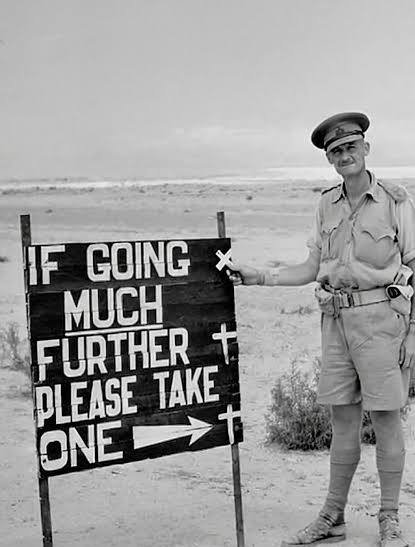
Typical Australian humour here, having a laugh even in the darkest of times. Image taken on the El Alamein road, 14 September 1942
Amidst the chaos of frontline combat and the challenging transitions back home, Catholic chaplains provided essential spiritual and pastoral support to troops, families, and widows. Below are special news reports detailing six significant historical days throughout October and the vital service of the "Sky Pilots" who accompanied those who served.
3 October: The Battle of Maryang San (1951)
Fought between 3 and 8 October 1951 during the Korean War, the Battle of Maryang San is widely regarded as "probably the greatest single feat of the Australian Army during the Korean War." As part of a United Nations offensive known as Operation Commando, troops from the 3rd Battalion, Royal Australian Regiment (3RAR), successfully captured heavily fortified mountain defences on Hill 317 (Maryang San) from a numerically superior Chinese force.
Throughout the fierce five-day combat and the relentless human-wave counterattacks that followed, military chaplains provided desperate comfort. Standing by the troops through extreme sub-zero conditions and artillery barrages, Catholic chaplains administered the Last Rites in the field and oversaw the dignified burial of the 20 Australians killed in action. Veterans frequently recalled how even those who considered themselves "retired Catholics" found their way back to prayer under the spiritual guidance of the padres amidst the muddy paddy fields and ridges.

3 October: Vietnam Forces Welcome Home Parade, Sydney (1987)
On 3 October 1987, 22,000 Vietnam veterans finally received the public recognition they deserved as they marched through the streets of Sydney. Coming 15 years after Australia's combat role ended, the parade drew hundreds of thousands of spectators. It healed deep emotional wounds for a generation of service personnel who had originally returned home "in the shadows" without public celebration.
Catholic military chaplains played a crucial role in the healing process before, during, and long after this momentous parade. Priests who served aboard the fast troop transport carriers HMAS Sydney and HMAS Melbourne—as well as those on the dangerous frontlines of South Vietnam—marched alongside their former units. These chaplains, often referred to affectionately by troops as "Sky Pilots," were vital in helping veterans process the "moral injuries" of a controversial war, bridging the gap between isolated combat trauma and community reintegration.

19 October: War Widows Day
War Widows Day officially honours the hidden sacrifices, resilience, and unique grief borne by the surviving partners and families of Australia’s veterans. The date marks the birthday of Mrs Jessie Vasey OBE CBE, who founded the War Widows' Guild in 1945 to ensure that women who lost their husbands to war were never abandoned by the government or society.
Catholic chaplains and pastoral care workers have historically formed the backbone of community-level support for war widows. While military padres provide comfort at the graveside, diocesan and hospital chaplains continue the vital spiritual work at home. They walk alongside grieving mothers and wives as they raise families alone, offering a "ministry of presence" that remains an indispensable lifeline for families navigating the lifelong, generational impacts of military loss.

23 October: Second Battle of Alamein (1942)
Begun on the night of 23 October 1942, the Second Battle of El Alamein was the turning point of the North African Campaign during WWII. General Montgomery famously declared that he "would as soon think of going into battle without my artillery as without my chaplains," highlighting the immense reliance placed on the spiritual fortitude of the troops.
The sands of Egypt saw extraordinary acts of valor from Catholic military chaplains. Prominent among them was Father Aquinas T. Colgan, an Australian Catholic Chaplain who fearlessly entered active minefields under heavy fire to drag wounded soldiers to safety and administer Last Rites. Similarly, Father Tom Steele earned a Mention in Despatches for his heroic service under fire with the 9th Australian Division at Alamein. Before the victorious units departed the desert, Fr Steele coordinated a massive open-air Requiem Mass in the Alamein cemetery, where over 2,000 soldiers spontaneously gathered to pray for their fallen mates.

24 October: United Nations Day
United Nations Day marks the anniversary of the entry into force of the UN Charter on 24 October 1945, established immediately following the horrific devastation of World War II to foster international cooperation and avert future global conflicts.
The Catholic Church has a storied history of supporting the UN's peacekeeping and humanitarian arms. Catholic military chaplains regularly deploy under the blue UN flag alongside international peacekeepers in volatile regions like Lebanon, Cyprus, and the Golan Heights. On this day, Catholic chaplains worldwide lead services dedicated to global peace, working directly on the ground to provide humanitarian outreach, distribute aid, and support communities displaced or torn apart by active warfare.

31 October: Charge of Beersheba (1917)
On 31 October 1917, the 4th Australian Light Horse Brigade launched one of history's last successful cavalry charges to capture the strategic town of Beersheba. Spurring their parched horses across six kilometres of open desert under intense Ottoman artillery and machine-gun fire, the Light Horsemen successfully secured vital water wells and turned the flank of the Turkish defensive line in Palestine.
In the immediate, bloody aftermath of the charge, military chaplains moved onto the battlefield while the dust was still settling. Chaplains like the Reverend W. J. Dunbar worked tirelessly through the night under the desert stars to identify the dead, comfort the dying, and bury the 31 light horsemen who fell during the charge. Catholic padres attached to the Desert Mounted Corps galloped close behind the charging lines, ensuring that even in the remote deserts of the Middle East, no soldier faced their final moments without spiritual accompaniment and the sacraments of the Church.
By the MO Media Team