
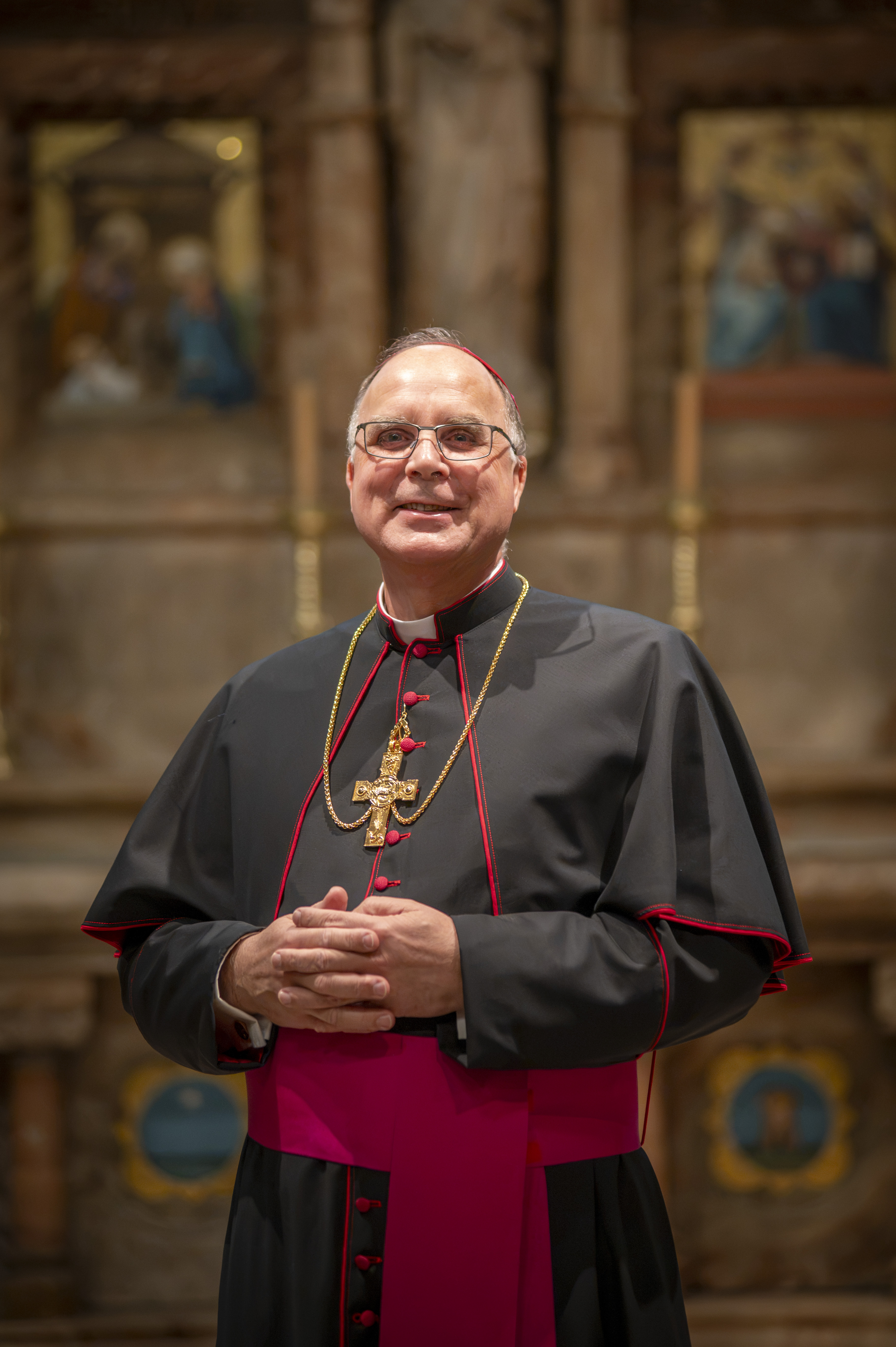
Bishop Stuart Hall (Melbourne Archdiocese/James Carrett)
On Remembrance Day, at the 11th hour of the 11th day of the 11th month, we are urged to observe a minute’s silence to remember all those who have died or suffered for Australia in its wars and armed conflicts.
But it’s also a minute of prayer, says the new Military Ordinary for the Australian Defence Forces, Bishop Stuart Hall.
“Silence in itself is the beginning of prayer,” he told The Catholic Weekly. “We stop what we’re doing and remember that every person who died in service had a name, they had a family, and they had a story. As Catholics, we entrust those who have died to God’s mercy.”
And it’s not just about the past. “It’s very much about asking God to help us build a more peaceful world.”
Bishop Hall is one of Australia’s newest bishops. He was ordained as the head of the Military Ordinariate on 29 August after the post had been vacant for about five years. There is a lot to do – and he has hit the ground running.
For example, three ADF cadets were received into the Catholic Church in October.
In fact, evangelisation is among Bishop Halls’s top priorities.
“Looking across the world, young people are coming back to faith. And the ADF is a major pool of young people,” he says.
“Within the Australian Defence Force, we have people who are seeking faith and wanting to investigate what does it mean to be a faithful person? What does it mean to believe in something that’s greater than myself or greater than what the world thinks is important?”
Life in the military offers unique pastoral challenges. ADF personnel are spread across Australia.
Large and small facilities are scattered across Sydney, from HMAS Kuttabul at Potts Point to Holsworthy Barracks near Liverpool to the RAAF Base at Richmond to Victoria Barracks in Paddington.
Bishop Hall plans to establish an organised catechetical programme so that military personnel can learn about the Catholic Church no matter where they are deployed.
In most dioceses, the Easter Vigil is the preferred moment for receiving people into the Church. But that’s not practical for the ADF.
“In parishes, there’s usually a very structured inquiry stage, catechetical stage, and at Easter they come and be baptised, confirmed, etc,” says Bishop Hall. “But in the military, because we move around, we have to be flexible,”
Preferably the program will be in person, he says. “Because at the end of the day, faith is not just purely intellectual. It’s a personal encounter with Jesus Christ. It’s that encounter with Jesus Christ within the community, within the life of the church, that allows us to be nourished and to be another Christ to other people as well.”
Even though Australia is an increasingly secular society, the ADF welcomes the help that chaplains give ADF personnel and their families.
“Chaplains just aren’t there just for the Sunday Mass or religious services,” he says.
“People come and see the chaplains, some with faith, some struggling with faith, some who have never been exposed to faith. But they understand that this person, this religious person, is someone who appreciates them, recognises their dignity, and will assist them as much as they can in the ordinary events of life and sometimes extraordinary events of life.”
The new bishop plans to spend the next year or so visiting military establishments and the families of ADF personnel.
In fact, he also hopes to visit parishes near bases.
“The constant message I’ll be making is for the parishioners who are there every week, to support the military families who come into their parishes,” he said. ADF families are always on the move and it is hard for them to maintain friendships in a parish.
“If we’re not being conscious of their need to reconnect and to be part of the parish, unfortunately, they’ll stop going. They’ll say, this is all too hard.
“So I encourage parishioners to make them welcome and keep on offering that invitation.”
His message for Remembrance Day?
Bishop Hall’s episcopal motto is Pax Christi mihi est dux, the peace of Christ is my leader. And on November 11, he urges everyone, whether or not they wear a uniform, to pray for peace.
“That peace is not something that we can just simply take for granted.
“It’s something that we have to work for in our families, in our communities, and in our nation. As Christians, we are called to be people of peace. That is the message Australia needs to hear at any time, but in particular on Remembrance Day.”