
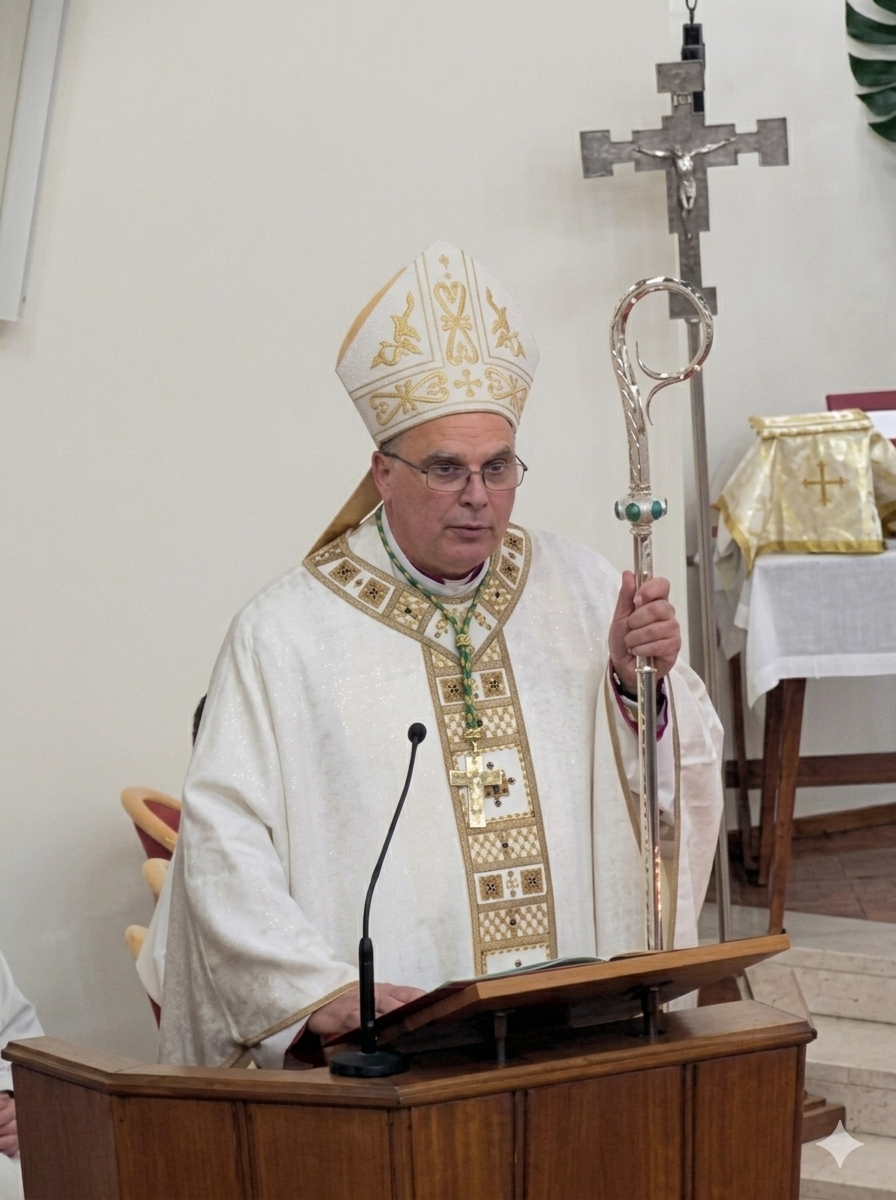
Image; Bishop Stuar Hall saying his first homily as Bishop of the Military Ordinariate of Australia
Sunday 26th Ordinary Time
Yr A RMC Chapel 5pm Inauguration Mass as Bishop to MO 2026 09/27
Today, as I enter this chapel as Bishop of the Military Ordinariate of Australia, I am conscious that this is much more than a building. This RMC Chapel is a sign of something much larger. It is a sign of the Church’s presence in the midst of the Australian Defence Force.
And while this chapel has a particular place in the life of the Military Ordinariate, it also represents every chapel, every base, every unit, every ship, every place and every gathering where Catholic members of the Australian Defence Force come together to pray, to celebrate the Eucharist, to seek forgiveness, to ask for guidance, and simply to be with the Lord.
That is where the Military Ordinariate belongs: in the midst of the lives of our people.
Our vocation is not to stand at a distance from military life. We are called to enter into it.
We are called to know the lives of the men and women whom we serve: their work, their friendships, their families, their hopes and fears, their sacrifices, their deployments, their successes and their disappointments.
We are called to be there when life is ordinary—and when life is anything but ordinary.
And today, in a particularly beautiful way, we have Henry and Elizabeth who will be receiving their First Holy Communion after a period of preparation. This is a very special moment in their sacramental journey and in their life of faith.
Today, Elizabeth and Henry you come to the altar for the first time to receive Jesus in the Eucharist—not simply to remember Jesus, but to receive him: Christ truly present, giving himself to us as food for the journey.
Henry and Elizabeth, my prayer for you today is that this First Holy Communion will be the beginning of a deep and lifelong friendship with the Lord.
May you always know that Jesus is close to you—in the joyful moments of your life, in the difficult moments, Jesus is close to you in your family and in your friendships, and wherever life’s journey takes you.
Elizabeth and Henry, may you return again and again to this altar, where the Lord nourishes us with his own life. And may the Eucharist strengthen you to know and encounter Christ, to love him, and to follow him faithfully throughout your life.
This is, in many ways, what the Military Diocese (Ordinariate) is called to do: to help people encounter Christ, to accompany them on the journey of faith, and to ensure that wherever their military vocation takes them, they know that the Lord is near.
This is why I have been reflecting on a recent letter of Pope Leo XIV. (Bishops of Latin America and the Caribbean on the occasion of the Third Centenary of the Canonization of Saint Turibius of Mogrovejo -published 19 Sept 2026)
In reflecting on the ministry of a bishop, the Holy Father draws our attention to the beautiful symbolism of the bishop entering his church and encountering the people entrusted to him.
The bishop does not enter simply to occupy a place. He enters in order to serve a people.
And that service must be lived in their midst.
Pope Leo speaks of the bishop having his heart in heaven and his feet on the road.
I think that is a particularly powerful image for a Military Diocese (Ordinariate).
Our hearts must always be directed towards Christ.
But our feet must be on the road, on the roads that lead to our bases, our units, to our fleet units, in our training establishments, and in the homes of Defence families. Into the places where our personnel gather. And sometimes into places where there is loneliness, anxiety, grief or suffering.
The ministry of the Military Ordinariate is therefore profoundly incarnational.
We do not simply wait for people to come to us. We go to them.
We enter into their world because Christ has entered into ours.
And this is where today’s Gospel speaks so powerfully.
The father says to his son,“My boy, you go and work in the vineyard today.”
The first son says no, but eventually goes. The second says yes, but does not go.
The Gospel reminds us that discipleship is ultimately measured not by what we say, but by whether we go. The Military Ordinariate is called to be a Church that goes.
A chaplain cannot be merely someone who is available when people walk through the chapel or office door. The chaplain is called to walk through their door.
To stand alongside them. To listen. To accompany. To pray. To celebrate. To teach.
To baptise. To reconcile. To bury. To bless. To walk with families.
To be present when someone returns from deployment—and when someone prepares to leave. And sometimes simply to sit quietly with someone when there are no adequate words.
This is servant leadership.
It is leadership understood through the pattern of Christ himself.
Saint Paul tells us today:
“In your minds you must be the same as Christ Jesus.”
And then he gives us that extraordinary hymn of Christ’s self-emptying.
Christ does not cling to his status.
He empties himself.
He takes the form of a servant.
He humbles himself. He becomes obedient.
That is the pattern of Christian leadership.
And so, as I begin this ministry among you, I do not want to understand episcopal leadership primarily in terms of authority.
I want to understand it first in terms of service.
The bishop serves.
The chaplain serves.
The priest serves.
The deacon serves.
The pastoral associate serves.
And we serve because Christ first came among us as the One who serves.
That is why the crucifix is so important.
The Cross is not simply something we carry. It tells us what our ministry must look like.
Before authority comes sacrifice.
Before leadership comes humility.
Before speaking comes listening.
And before asking others to follow, we must ourselves follow Christ.
So, as I stand before today - I do so with gratitude—but also with humility.
I know that I have been entrusted with a responsibility.
But I also know that this is not my Diocese (Ordinariate).
It is Christ’s.
These are not my people.
They are Christ’s people.
And this chapel, and all our chapels - belongs to the people of God who gathered here.
And it points beyond itself to every place where Catholic Defence personnel gather.
Wherever they gather, Christ’s Church must be there.
Wherever they serve, the Church must serve alongside them.
Wherever they carry responsibility, the Church must accompany them.
Wherever they suffer, the Church must not be absent.
And wherever they seek meaning, truth, forgiveness and hope, the Church must proclaim Jesus Christ.
This is why I return to the words which have become so important to me:
Pax Christi mihi est Dux -The peace of Christ is my leader.
Christ is our Dux.
He is the One who leads us. He is the One whom we follow.
And so perhaps the most important question for us is not simply, “What should we do?”
It is: “Lord, where are you leading us?”
And then, having prayed that question, having listened to one another, and having listened to our people, we must have the courage to go.
To go into the vineyard.
To go into the midst of the Australian Defence Force.
To go into the lives of the men and women entrusted to our care.
And to serve there—not as strangers looking in, but as servants walking with them.
If we can do that faithfully, then every chapel in this Diocese (Ordinariate) can become what this chapel symbolises today:
a place where Christ is encountered;
a place where the Eucharist is celebrated;
a place where wounds are brought to the Lord;
a place where vocations are discovered;
a place where faith is strengthened;
and a place from which disciples are sent into the world.
For the chapel is not the boundary of our mission.
It is the place from which our mission begins.
And so, as I begin this ministry, I entrust myself, our chaplains, our pastoral associates, our Defence personnel and their families to the maternal care of Mary.
Our Lady, Help of Christians, Patroness of the Australian Military Ordinariate, pray for us.
Teach us to follow your Son.
Teach us to listen and to serve.
Teach us to stand faithfully beside those entrusted to our care.
And when the road is difficult, remind us that the One whom we follow has already gone before us.
May Christ be our peace.
May Christ be our leader.
May Christ be our Dux.
And may everything we do in this Catholic Military Diocese be for his glory and for the good of those whom we are called to serve.
+ Stuart Hall